Reparations for Black Americans: Here’s what some state and local governments are doing | CNN
Tag: Black History
-
Reparations for Black Americans: Here’s what some state and local governments are doing | CNN
-
OnPolitics: Virginia elects its first Black woman to Congress. What’s next?
OnPolitics: Virginia elects its first Black woman to Congress. What’s next? -
Black History – CRT – 020123
36 states have restricted education on racism, bias, the contributions of specific racial or ethnic groups to U.S. history, or related topics.
The true measure of public education is how well it teaches students to function in a democratic, pluralistic society.
Brown v. Board of Education, Southern school districts that were intentionally segregated were subject to constitutional remedies that were supervised by the federal court. many re-segregated after changes in the law made it easier for federal courts to release them from supervision. In other parts of the country where cities were segregated—but not by law—the only way to integrate was through metropolitan desegregation plans that crossed into the suburbs. But the 1974 United States Supreme Court case Milliken v. Bradley, limited the power of federal courts to order integration across school district boundaries.
-

Edwin Pratt – Did You Know?
On a snowy night in 1969, Edwin was shot in his home, while Miriam and her mother, Bettye, were inside.
“I remember, I heard my mother cry ‘Edwin!’ and I sat up in the bed, and I was immediately engulfed in fear,” Miriam, now 55, tells Jean.
Jean and her mother were Pratts’ neighbors. They rushed over after receiving a phone call from Bettye.
“When I saw that front door was open, I knew. I knew,” says Jean, who was 21 at the time. “I’ll never forget walking into that family room and I could see your dad laying there and, of course, he was totally still. He died instantly.”
Jean Soliz and Miriam Pratt raise fists a few months after Edwin Pratt’s assassination in 1969. Inspired by Edwin and his wife Bettye, who had been a social worker, Jean went on to have a career in social services.
Jean ran and got Miriam from her room. For Miriam, that’s when “I knew everything was going to be alright,” she says.
Edwin had spent his last day playing with his daughter. “He played snowballs with you and took you on your little sled and spent that whole day with you,” Jean tells Miriam. “Which I think is a marvelous thing.”
After his death, Miriam’s mom didn’t talk much about Edwin, because it made her sad. Miriam was able to learn about him through a photo album that Bettye had put together. It was filled with newspaper clippings, obituaries, and personal pictures of Edwin.
What’s different about this story is what this little girl did all because she walked past a plaque for Edwin Pratt
-

#WebsterGrove
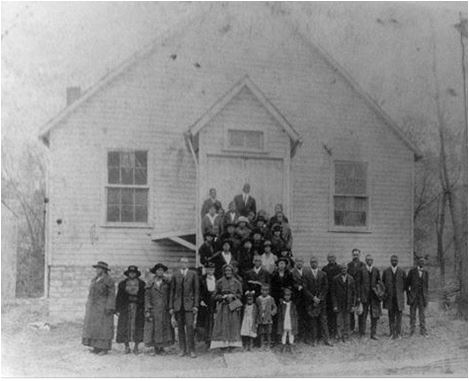
At the end of the Civil War, many black families, formerly enslaved, found their way to Webster Groves. They began to settle on Vinegar Hill and along Shady Creek. One of these persons was Ken Lankford, who was a preacher. He began preaching, just after the war in 1865, in a brush arbor, alongside Shady Creek. The trees there also provided shade for those who attended his services.
A year later, in 1866, William Porter helped to formally organize the church and it became the First Baptist Church of Webster Groves. Allen Brown contributed the first $25 for the church building, which had 18 other original members. Those members built the first church in their community, making sure it had a tall foundation because of its location near Shady Creek. Churches have long been a part of creating a community, and the First Baptist Church of Webster Groves did the same in North Webster.
The year that the First Baptist Church of Webster Groves was created, an English woman came through Webster Groves on a mission to establish schools for black children throughout Missouri. She was working for the assistant state superintendent of public schools, James Milton Turner, who was in charge of postwar black schools. Mrs. Dotwell, as she is only recorded, began the first school for black children in Webster Groves at the First Baptist Church in 1866 and taught black children there until the Webster Groves School District undertook its responsibility in 1868. At that time, there were 30 children in North Webster eligible to attend between the ages of 5 and 21. The school later became known as Douglass and the church still stands, albeit, in a new building.
-

#Juneteenth Never Forget
Juneteenth is a holiday celebrating the liberation of those who had been held as slaves in the United States. Originally a Texas state holiday, it is now celebrated annually on the 19th of June throughout the United States.


-
What Have We Accomplished By Protesting
👉🏾Within 10 days of sustained protests:
Minneapolis bans use of choke holds.👉🏾Charges are upgraded against Officer Chauvin, and his accomplices are arrested and charged.
👉🏾Dallas adopts a “duty to intervene” rule that requires officers to stop other cops who are engaging in inappropriate use of force.
👉🏾New Jersey’s attorney general said the state will update its use-of-force guidelines for the first time in two decades.
👉🏾In Maryland, a bipartisan work group of state lawmakers announced a police reform work group.
👉🏾Los Angeles City Council introduces motion to reduce LAPD’s $1.8 billion operating budget.
👉🏾MBTA in Boston agrees to stop using public buses to transport police officers to protests.
👉🏾Police brutality captured on cameras leads to near-immediate suspensions and firings of officers in several cities (i.e., Buffalo, Ft. Lauderdale).
👉🏾Monuments celebrating confederates are removed in cities in Virginia, Alabama, and other states.
👉🏾Street in front of the White House is renamed “Black Lives Matter Plaza.”
Military forces begin to withdraw from D.C.Then, there’s all the other stuff that’s hard to measure:
💓The really difficult public and private conversations that are happening about race and privilege.
💓The realizations some white people are coming to about racism and the role of policing in this country.
💓The self-reflection.
💓The internal battles exploding within organizations over issues that have been simmering or ignored for a long time. Some organizations will end as a result, others will be forever changed or replaced with something stronger and fairer.
Globally:
🌎 Protests against racial inequality sparked by the police killing of George Floyd are taking place all over the world.
🌎 Rallies and memorials have been held in cities across Europe, as well as in Mexico, Canada, Brazil, Australia, and New Zealand.
🌎 As the US contends with its second week of protests, issues of racism, police brutality, and oppression have been brought to light across the globe.
🌎 People all over the world understand that their own fights for human rights, for equality and fairness, will become so much more difficult to win if we are going to lose America as the place where ‘I have a dream’ is a real and universal political program,” Wolfgang Ischinger, a former German ambassador to the US, told the New Yorker.
🌎 In France, protesters marched holding signs that said “I can’t breathe” to signify both the words of Floyd, and the last words of Adama Traoré, a 24-year-old black man who was subdued by police officers and gasped the sentence before he died outside Paris in 2016.
🌎 Cities across Europe have come together after the death of George Floyd:
✊🏽 In Amsterdam, an estimated 10,000 people filled the Dam square on Monday, holding signs and shouting popular chants like “Black lives matter,” and “No justice, no peace.”
✊🏽 In Germany, people gathered in multiple locations throughout Berlin to demand justice for Floyd and fight against police brutality.
✊🏾 A mural dedicated to Floyd was also spray-painted on a stretch of wall in Berlin that once divided the German capital during the Cold War.
✊🏿 In Ireland, protesters held a peaceful demonstration outside of Belfast City Hall, and others gathered outside of the US embassy in Dublin.
✊🏿In Italy, protesters gathered and marched with signs that said “Stop killing black people,” “Say his name,” and “We will not be silent.”
✊🏾 In Spain, people gathered to march and hold up signs throughout Barcelona and Madrid.
✊🏾 In Athens, Greece, protesters took to the streets to collectively hold up a sign that read “I can’t breathe.”
✊🏾 In Brussels, protesters were seen sitting in a peaceful demonstration in front of an opera house in the center of the city.
✊🏾In Denmark, protesters were heard chanting “No justice, no peace!” throughout the streets of Copenhagen, while others gathered outside the US embassy.
✊🏾 In Canada, protesters were also grieving for Regis Korchinski-Paquet, a 29-year-old black woman who died on Wednesday after falling from her balcony during a police investigation at her building.
✊🏾 And in New Zealand, roughly 2,000 people marched to the US embassy in Auckland, chanting and carrying signs demanding justice.
💐 Memorials have been built for Floyd around the world, too. In Mexico City, portraits of him were hung outside the US embassy with roses, candles, and signs.
💐 In Poland, candles and flowers were laid out next to photos of Floyd outside the US consulate.
💐 And in Syria, two artists created a mural depicting Floyd in the northwestern town of Binnish, “on a wall destroyed by military planes.”
Before the assassination of George Floyd some of you were able to say whatever the hell you wanted and the world didn’t say anything to you…
THERE HAS BEEN A SHIFT, AN AWAKENING…MANY OF YOU ARE BEING EXPOSED FOR WHO YOU REALLY ARE. #readthatagain
Don’t wake up tomorrow on the wrong side of this issue. Its not to late to SAY,
“maybe I need to look at this from a different perspective.
Maybe I don’t know what its like to be Black in America…
Maybe, just maybe, I have been taught wrong.”
There is still so much work to be done. It’s been a really dark, raw week. This could still end badly. But all we can do is keep doing the work.
Keep protesting.
WE ARE NOT TRYING TO START A RACE WAR; WE ARE PROTESTING TO END IT,
PEACEFULLY.How beautiful is that?
ALL LIVES CANNOT MATTER UNTIL YOU INCLUDE BLACK LIVES.
YOU CANNOT SAY ‘ALL LIVES MATTER’ WHEN YOU DO NOTHING TO STOP SYSTEMIC RACISM & POLICE BRUTALITY.
YOU CANNOT SAY ‘ALL LIVES MATTER’ WHEN BLACK PEOPLE ARE DYING AND ALL YOU COMPLAIN ABOUT IS THE LOOTING.
YOU CANNOT SAY ‘ALL LIVES MATTER’ WHEN YOU ALLOW CHILDREN TO BE CAGED, VETERANS TO GO HOMELESS, AND POOR FAMILIES TO GO HUNGRY & LOSE THEIR HEALTH INSURANCE.
DO ALL LIVES MATTER? YES. BUT RIGHT NOW, ONLY BLACK LIVES ARE BEING TARGETED, JAILED, AND KILLED EN MASSE- SO THAT’S WHO WE’RE FOCUSING ON.
🖤🖤🖤BLACK LIVES MATTER🖤🖤🖤
IF YOU CAN’T SEE THIS, YOU ARE THE PROBLEM.
-
Doris Davis #Compton
-
Margaret E. Morton – The Woman Who Would Not Step Aside
In these days of analyzing confusing elections and examining consequential figures in our past, people who cleared a path for our future stand out. Margaret E. Morton had an extraordinary career in Connecticut politics that was sparked by her role in a Bridgeport neighborhood issue. In the early 1970’s, she and other East End residents had asked the city to install a stop sign at the site of frequent accidents. Their request was rejected by the city, symptomatic of a growing chasm between white city leaders and East End’s black residents.The East Enders struck back, organizing to support black candidates for elected office. Margaret Morton ran as the Democratic Party’s candidate for a vacant seat in the state House of Representatives in 1972. Her victory catapulted Morton into Connecticut history: she was the first African-American woman elected to the General Assembly.
In 1980, Margaret Morton decided to run for the state Senate after the incumbent, a well-known attorney, told her he wouldn’t seek re-election. Margaret Morton later learned that the attorney intended to run and the Democratic Party machinery wanted her to withdraw her name for consideration. “I was told, not asked, to step aside,” she said.
In her interpersonal dealings, Margaret Morton’s soft-spoken and gracious demeanor was in stark contrast to the wise-cracking, cigar chomping political operatives in Bridgeport. Margaret Morton’s rivals may have underestimated her tenacity and organizational skills. Among her supporters: newly deputized registrars of voters that enlisted people to register as voters affiliated with the Democratic Party.[1] The voter registration drive paid off. Margaret Morton beat the attorney by eight votes in a primary election, clearing the way for her to become the first African-American woman in Connecticut’s state Senate. She subsequently rose to the rank of Deputy President Pro Tempore, a leadership role she held until she retired from the General Assembly in 1992.[2]
During her tenure, Margaret Morton championed causes to help impoverished people in the state’s urban areas. She supported the adoption of a state income tax, for instance. “People continue to talk about cutting spending. When you cut spending in the government you’re cutting people, which in return are services to people,” she said.[3] In the Assembly, Morton chaired the committee on Human Rights and Opportunities and rose to the rank of Assistant House Majority Leader. She oversaw the appointment of two African American judges during her years in office. In total, she served four terms as a State Representative and six terms as a State Senator.
Margaret Morton was born in 1924 in Pocahontas, Virginia, to Aaron and Leona (Hurt) Woods. She was raised in Bluefield, West Virginia and graduated from high school summa cum laude. [4] After marrying James Morton in 1941, the couple moved to Bridgeport, then a vibrant manufacturing center.
The Mortons, who had four children, established and ran Morton’s Mortuary funeral home in Bridgeport’s East End. All throughout her political career, she never forgot her roots. Upon being named Deputy President Pro Tempore, Morton made the following Statement: My grandfather was the child of the master in the slaves and he yearned for education, he longed for education. He went as far as he could go in school and he taught. One thing he instilled in his children and he sent them all to normal school in those days which allowed them to become whatever they wanted to become and some were teachers and others entered into other professions. But I think that man is happy today, looking down to see his granddaughter in this position. And my mother is happy and all of you know my mother and you know all about my mother. I know she is happy today. And you know what else? I think she believes all the nice things these nice guys said about me. Because she really believed in me. [5] Margaret Morton died March 10, 2012. Fulfilling her grandfather’s dream, Margaret Morton had become a role model for future generations. On the day that she would have turned 88, Bridgeport City Hall’s annex was renamed in her honor at a ceremony befitting a trailblazer.
[1] http://www.washingtonpost.com/archive/politics/1984/06/24/flip-side-of-voter-drives-can-be-polarized-parties/bb514a93-8dbc-4856-8429-5e307f06ebff/
[2] http://www.ct.gov/sots/lib/sots/registermanual/2012dedicationweb.pdf
[3] “Weicker Gets His Income Tax, But Citizens Fight It,” The Christian Science Monitor, 08 Oct 1991.
[4] http://www.legacy.com/obituaries/ctpost/obituary.aspx?pid=156477743
[5] Senate Session Transcript 02/14/90 [http://search.cga.state.ct.us/dtsearch.asp?cmd=getdoc&DocId=7395&Index=I%3A%5Czindex%5C1990&HitCount=0&hits=&hc=0&req=&Item=425]
Source: By Mary Witkowski – Bridgeport Public Library