Category: Black History

  • Dark Days in Alabama – #Molestation

    These Trump supporters trying to rationalize CHILD MOLESTATION in order to justify voting for Roy Moore is so sickening, it’s almost scary.

    Alabama legislators passed a law in July 2010 which makes it a felony crime for a school employee to engage in a sex act with a student. The class B felony crime comes with a punishment of two to 20 years in prison, if convicted.

    The history of child protection in America is divisible into three eras.

    1. Colonial Times to 1875;
    2. 1875 to 1962 – when nongovernmental organized child protection agencies began to increase;
    3. 1962 marks the era of government sponsored CPS;

    One of the members of the panel states that 40 years ago in 1977 this type of behavior was typical of children in Alabama!

    In Mobile Alabama on November 14, 2012 jurors listened to the closing arguments in Mobile County on a case of molestation and was unable to reach a moment. Defense attorney Walter Honeycutt reminded jurors during his summation at the girl was vague about when the oral sex occurred but that it was before a fish fry at about 3 p.m. The defendant testified that he could not have molested the child at that time because he regularly volunteered to cook fish fries on Friday afternoons during Lent at his church and would not have been around the girl.

    Again – MOBILE, Alabama    – A hung jury has led to a mistrial in the case of a midtown Mobile man accused of sexually abusing two young girls in their bedroom on Mother’s Day night 2013.

    Roy Moore, the Republican candidate for U.S. Senate in Tuesday’s Alabama special election, is credibly accused of sexually preying upon a 14-year-old girl and forcing himself upon a 16-year-old girl as a thirtysomething prosecutor.

    He is uniquely disqualified from public office separate and apart from those terrible misdeeds.

    He was twice removed as chief justice of his state’s highest court for disrespecting the rule of law: in 2003, for disobeying an order to remove a monument of the 10 Commandments; in 2016, for directing probate judges to ignore a U.S. Supreme Court ruling.

    All I have to say is:

    3The fining pot is for silver, and the furnace for gold: but the LORD trieth the hearts. 4A wicked doer giveth heed to false lips; and a liar giveth ear to a naughty tongue. 5Whoso mocketh the poor reproacheth his Maker: and he that is glad at calamities shall not be unpunished. 6Children’s children are the crown of old men; and the glory of children are their fathers. 7Excellent speech becometh not a fool: much less do lying lips a prince. 8A gift is as a precious stone in the eyes of him that hath it: whithersoever it turneth, it prospereth. 9He that covereth a transgression seeketh love; but he that repeateth a matter separateth very friends.

    View the Trump Supporters Video Here

    Sources: Facebook, Family Law Quarterly, Vol 42, Mobile Jurors; 

    McKinley Report  Daily News

    The best deterrent to heartache in the life of a child is the presence of a well-informed parent. BE INFORMED~ Donna Funderburke McKinley


  • To #Kneel or Not to Kneel


    President Dokneelnald Trump claimed Tuesday that the National Football League is “having a very hard time” filling stadiums because Americans are “fed up” with players protesting during the national anthem.


    But contrary to Trump’s tweet Tuesday, they did not all kneel during the anthem. Ten remained seated, four raised a fist, nine took a knee, and one remained off the field completely, according to an ESPN log.

    Is NFL attendance down?

    Trump claimed Tuesday that stadiums “are now having a very hard time filling up,” building on a Nov. 20 tweet that attendance was “way down.”

    But that’s not true, according to the NFL.

    Source:  NBC News


  • #FreeSpeech #Kaepernick

    Freedom of speech

    Congress shall make no law respecting an establishment of religion, or prohibiting the free exercise thereof; or abridging the freedom of speech, or of the press; or the right of the people peaceably to assemble, and to petition the government for a redress of grievances.

    First is the matter of racial equality. When slavery was abolished, it was not by constitutional fiat but by the joining of military necessity with the moral force of a great antislavery movement, acting outside the Constitution and often against the law. The Thirteenth, Fourteenth and Fifteenth Amendments wrote into the Constitution rights that extralegal action had already won. But the Fourteenth and Fifteenth Amendments were ignored for almost a hundred years. The right to equal protection of the law and the right to vote, even the Supreme Court decision in Brown v. Board of Education in 1954 underlining the meaning of the equal protection clause, did not become operative until blacks, in the fifteen years following the Montgomery bus boycott, shook up the nation by tumultuous actions inside and outside the law.

    The Constitution played a helpful but marginal role in all that. Black people, in the political context of the 1960s, would have demanded equality whether or not the Constitution called for it, just as the antislavery movement demanded abolition even in the absence of constitutional support.
    What about the most vaunted of constitutional rights, free speech? Historically, the Supreme Court has given the right to free speech only shaky support, seesawing erratically by sometimes affirming and sometimes overriding restrictions. Whatever a distant Court decided, the real right of citizens to free expression has been determined by the immediate power of the local police on the street, by the employer in the workplace and by the financial limits on the ability to use the mass media.

    The existence of a First Amendment has been inspirational but its protection elusive. Its reality has depended on the willingness of citizens, whether labor organizers, socialists or Jehovah’s Witnesses, to insist on their right to speak and write. Liberties have not been given; they have been taken. And whether in the future we have a right to say what we want, or air what we say, will be determined not by the existence of the First Amendment or the latest Supreme Court decision but by whether we are courageous enough to speak up at the risk of being jailed or fired, organized enough to defend our speech against official interference and can command resources enough to get our ideas before a reasonably large public.
    The language of the First Amendment looks absolute. “Congress shall make no law . . . abridging the freedom of speech.” Yet in 1798, seven years after the First Amendment was adopted, Congress did exactly that, it passed laws abridging the freedom of speech-the Alien and Sedition Acts.

    The powerful words of the First Amendment seem to fade with the sounds of war, or near war. The Sedition Act of 1798 expired, but in 1917 when the United States entered World War I, Congress passed another law in direct contradiction of the amendment’s command that “Congress shall make no law . . . abridging the freedom of speech, or of the press.” This was the Espionage Act of 1917.

    “The most stringent protection of free speech would not protect a man in falsely shouting fire in a theater and causing a panic…. The question in every case is whether the words used are used in such circumstances and are of such a nature as to create a clear and present danger that they will bring about the substantive evils that Congress has a right to prevent.”
    … the national government can restrict freedom of speech in relation to foreign policy, through judicial reinterpretations of the First Amendment. But what about state laws restricting freedom of speech or press? For over a century, the First Amendment simply did not apply to the states, because it says, ”Congress shall make no law.” The states could make whatever laws they wanted.

    Four years later, however, when a group of people were arrested in a shopping mall for distributing leaflets against the Vietnam War, the Court said they were properly arrested. What was the difference between this case and the other? The union people, the Court said, were expressing themselves about an issue connected with the shopping center. But the Vietnam War had nothing to do with the shopping center, so those people had no First Amendment right to express themselves.’ Much like the kneeling – which is directed towards police brutality of African American folk, yet the anthem, the flag nor football has any connection with police brutality.
    The point in all this recounting of cases is that citizens cannot depend on the First Amendment, as interpreted by the courts, to protect freedom of expression. One year the Court will declare, with inspiring words, the right of persons to speak or write as they wish. The next year they will take away that right.

    A young black man named Charles MacLaurin learned this by hard experience in the year 1963. That summer, he addressed a group of fifty black people in front of the courthouse in Greenville, Mississippi, protesting the arrest of several young black people who had been demonstrating against racial segregation. It was a peaceful meeting, in which MacLaunn criticized the conviction and urged that blacks register to vote to deal with such injustices. A police officer told McLaurin to move on. He said he had a right to speak and continued. He was arrested, charged with disturbing the peace and resisting arrest, found guilty by the local court, sentenced to six months in jail, and this was affirmed by the Mississippi Supreme Court.
    When he appealed to the U.S. Supreme Court, he discovered the rule that most citizens (who grow up hearing again and again from some aggrieved person: “I’ll take this to the Supreme Court!”) don’t know: Four of the nine justices must agree to take a case (in technical terms, to grant certiorari). Only three Supreme Court justices voted to take MacLaurin’s case. By now, it was 1967, and so, four years after his conviction, he went to prison.

    An even more serious problem with the First Amendment is that most situations involving freedom of expression never make it into the courts. How many people are willing or able to hire a lawyer, spend thousands of dollars, and wait several years to get a possible favorable decision in court? That means that the right of free speech is left largely in the hands of local police. What are policemen likely to be most respectful of-the Constitution, or their own “police powers”?

    This is always the price of liberty-taking the risk of going to jail, of being beaten and perhaps being killed.

    Source Howard Zinn

  • Ben Carson – Slaves and the Carnival Cruise Ship Filled with Hot Dying Men/Women and Children with Dreams and Aspiration of a Better Africa


    The Dialectical Fluidity of Race —

    Between self-definition and other-definition, between an individual’s chosen racial identity versus society’s imposed racial identity — facilitates an understanding of race as a social construction

    Ben Carson – Slaves and the Carnival Cruise Ship Filled with Hot Dying Men/Women and Children with Dreams and Aspiration of a Better Africa

    WASHINGTON ― Ben Carson made his debut as secretary of Housing and Urban Development Monday by telling agency employees about the virtues of the “can-do” American society. Carson said this value system was best exemplified by slaves, whom he characterized as immigrants who came to the United States with very little and worked very hard.

    “That’s what America is about,” Carson said. “A land of dreams and opportunity. There were other immigrants who came here in the bottom of slave ships, worked even longer, even harder for less. But they too had a dream that one day their sons, daughters, grandsons, granddaughters, great grandsons, great granddaughters might pursue prosperity and happiness in this land.”

    By 1830 slavery was primarily located in the South, where it existed in many different forms. African Americans were enslaved on small farms, large plantations, in cities and towns, inside homes, out in the fields, and in industry and transportation.

    Though slavery had such a wide variety of faces, the underlying concepts were always the same. Slaves were considered property, and they were property because they were black. Their status as property was enforced by violence — actual or threatened. People, black and white, lived together within these parameters, and their lives together took many forms.

    Enslaved African Americans could never forget their status as property, no matter how well their owners treated them. But it would be too simplistic to say that all masters and slaves hated each other. Human beings who live and work together are bound to form relationships of some kind, and some masters and slaves genuinely cared for each other. But the caring was tempered and limited by the power imbalance under which it grew. Within the narrow confines of slavery, human relationships ran the gamut from compassionate to contemptuous. But the masters and slaves never approached equality.

    View the Video Here

    Black Group Identity

    Work on Black group identity is not easy to characterize, in part because of relatively limited research on this issue, especially that which examines ethnic group differences (Porter and Washington, 1993). Typically, analysis highlights the influence of social class on identity (e.g., Landry, 1987; Farley, 1984). Some inquiry suggests that class is only a part of the puzzle. Broman et al. (1988) reveal that older, less-educated respondents in urban areas and highly-educated Blacks living outside the West were most likely to feel close to other Blacks. Gurin et al. (1989) show that identity, defined as common fate and as more Black than American, was not simply related to class. Males and those of upperclass status were more likely to feel a common fate with Blacks. Younger Blacks and those who did not work full-time were also more likely to feel more Black than American. Williams, T. K., & Thornton, M. C. (1998).

    Introduction to the Subfield

    The sociology of race and ethnicity began to take shape in the late 19th century. The American sociologist W.E.B. Du Bois, who was the first African-American to earn a Ph.D. at Harvard, is credited with pioneering the subfield within the United States with his famous and still widely taught books The Souls of Black Folk and Black Reconstruction.

    However, the subfield today differs greatly from its early stages. When early American sociologists focused on race and ethnicity, du Bois excepted, they tended to focus on the concepts of integration, acculturation, and assimilation, in keeping with the view of the U.S. as a “melting pot” into which difference should be absorbed. Concerns during the early 20th century were for teaching those who differed visually, culturally, or linguistically from the white Ango-Saxon norms how to think, speak, and act in accordance with them. This approach to studying race and ethnicity framed those who were not white Anglo-Saxon as problems that needed to be solved and was directed primarily by sociologists who were white men from middle to upper-class families.

    As more people of color and women became social scientists throughout the twentieth century, they created and developed theoretical perspectives that differed from the normative approach in sociology, and crafted research from different standpoints that shifted the analytic focus from particular populations to social relations and the social system.

    Note: Ben Carson you should take another look…

    Source:  Huffington Post

    Source:  The American Slave: A Composite Autobiography, George P. Rawick, General Editor, with A Comprehensive Name Index for The American Slave, compiled by Howard E. Potts and Subject Index, from Index to The American Slave, edited by Donald M. Jacobs, assisted by Steven Fershleiser.

    Source:  PBS

    Source: Williams, T. K., & Thornton, M. C. (1998). Social construction of ethnicity versus personal experience: The case of afro-amerasians. Journal of Comparative Family Studies, 29(2), 255-267. Retrieved from http://nclive.org/cgi-bin/nclsm?url=http://search.proquest.com/docview/232586794?accountid=13217

  • Black men in #Chicago

    An email this morning from The Black Star Project read, “89% of young Black men in Chicago 16- to 19-years old are not working. 43% of young Black men in Chicago 20- to 24-years old are not in school and not working.  Now we know why there is so much violence in Chicago.  Brothers gotta eat and feed they seed!  Please Click Here to ask President Donald Trump for assistance to put these young Black men to work and reduce violence in Chicago.”


    Are you kidding me, are you seriously requesting folks to contact the current #potus for assistance to put our “young Black Men” to work?  With all the resources “we” have “we” can put a plan together to help those that look like us?  Are the Chicago Representatives unable to facilitate a program incorporating residents of Chicago?  I guess the element of desire would need to be a factor in facilitating relief for the remaining 43%.   That would mean that folks would have go onto the streets of neighborhoods they would rather see from the “flat screen” in a secure safe environment.

    Duckworth, Tammy – (D – IL)
    G12 Dirksen Senate Office Building Washington DC 20510
    (202) 224-2854
    Contact: http://www.duckworth.senate.gov/content/contact-senator


    Durbin, Richard J. – (D – IL)
    711 Hart Senate Office Building Washington DC 20510
    (202) 224-2152
    Contact: http://www.durbin.senate.gov/contact/

    As I watched the DNC Chair Candidate Forum there were few statements I remember – Robert Vinson Brannum and Keith Ellison – “…it’s time to step up…”


    It’s time those of us who have $2.00 more than we did 20 years ago to take our Blue and Black Perry Ellis suits jackets off and roll up our sleeves and go back to the neighborhoods from which we came and walk through the door of shame, guilt, and look and faces of our young black men and women who have no purposeful vision and each one literally take one by the hand and walk them on the #bus of opportunity.


    https://www.c-span.org/video/?c4656426/dnc-future-forum-baltimore


  • Watch Night 2017

    watchnight

    The Black Community

    On This date in 1862 the first Watch Night Services were celebrated in Back communities in America.

    The Watch Night service can be traced back to gatherings also known as “Freedom’s Eve.” On that night, Black slaves and free blacks came together in churches and private homes all across the nation awaiting news that the Emancipation Proclamation actually had become law.  At the stroke of midnight, it was January 1, 1863; all slaves in the Confederate States were declared legally free. When the news was received, there were prayers, shouts and songs of joy as many people fell to their knees and thanked God.

    Huffington Post

    “Watch Night Service” in the Black Church in America symbolizes the historical fact, that on the night of Dec. 31, 1862 during the Civil War, free and freed blacks living in the Union States gathered at churches and/or other safe spaces, while thousands of their enslaved black sisters and brothers stood, knelt and prayed on plantations and other slave holding sites in America — waiting for President Abraham Lincoln to sign the Emancipation Proclamation into law. The Emancipation Proclamation legally recognized that the Civil War was fought for slavery.

    Methodist

    There’s another explanation of the Watch Night Service.  It is said that the slaves in the Old Suth would gather in desperation on the last night of the year to await news regarding which of them would be sold on New Year’s Day to satisfy their masters’ outstanding debts.  Which is unlikely considering they would have no reason to wait for January 1st to sell slaves to pay off creditors.

    The practice may have begun with the Moravians, a small Christian denomination in Europe held in 1733 on the estate of a German count.

    On this day in 1770, America’s first-known “watch-night” service was held at St. George’s Methodist Church in Philadelphia.

    Watch Night services are a tradition started by John Wesley, the founder of the United Methodist Church. In all honesty, he borrowed the tradition from Moravian Christians that used them as a late-night vigil for the faithful; however, as time marched on, John molded this into a New Year’s Eve service where Christians were invited to review the year, confess to sins and pray for the year ahead. These services remain in Methodist worship manuals as “Covenant Renewal Services.

    What are you watching for on this 2016 – 2017 Watchnight?

    Source:

    http://www.aaregistry.org/historic_events/view/first-watch-night-service-occurs

    http://blackchristiannews.com/2016/12/john-wesley-the-methodist-church-and-the-history-of-the-first-watch-night-service/

    http://www.huffingtonpost.com/rev-joan-r-harrell/watch-night-service-in-the-black-church-in-america-150-years-_b_2389965.html

    From Christmas to Twelfth Night in Southern Illinois by John J. Dunphy

  • President Obama Signs ‘Emmett Till Bill’ To Reopen Civil Rights Cold Cases

    Well, well, well now that’s a gift!!!! Merry Christmas,

    The new legislation will allow civil rights cold cases that happened prior to 1970 to be reopened.

    Source: President Obama Signs ‘Emmett Till Bill’ To Reopen Civil Rights Cold Cases

  • Black History – What You May Not Know About the Women

    avant-nicoleNicole Avant served a two-year term as U.S. Ambassador to the Bahamas from 2009 to 2011. President Barack Obama nominated her for the position in 2009 and after U.S. Senate confirmation, Hilary Clinton, then Secretary of State, swore her into office on September 9, 2009.  Avant arrived in Nassau, the capital of the Bahamas, and presented her credentials on October 22, 2009.

    Avant, born on March 6, 1968, is the daughter of Clarence Avant and Jacqueline Avant, both veterans of the music recording industry.  She graduated from California State University Northridge with a B.A. in communications in 1984.  Soon afterwards she joined A&M Records in Los Angeles and worked in its promotions division until 1998 when she was named Vice President of Interior Music Publishing. Avant was also an actress who had appeared in television shows such as JAG, Moesha and the Bernie Mac Show.

     Source: Black Past
    ________________________________________________________________

    As I began to think about Black History for 2017 I started my search in usual fashion – entering “Black History” into the search box and clicking and pointing and deleting those unnecessary automatic downloads. It occurred to me as it has a hundred times before, I want something a little more than the same ol’ Bus Story, the Underground Train, The Book Writer, and the Little Rock Story… you know the “Safe” Black Women that educators in elementary and unfortunately secondary school don’t mind the over abundance of retelling those great stories about some incredible Black Women.


    angela-davis

    This time around I’m hungry for something more, something a lot more shocking and mind opening to idea of really gauging how far we have not come in the Land of the Free and Home of the Brave.

    Ride with me on my quest to find those little unknown stories about Black African-American Women and the stories they died to tell…

    During the 1820’s Susan Jackson of Savannah, Georgia, ran a popular pastry shop in Reynolds Ward, the leading business section of the city, and during the next decade Eliza Seymour Lee owned a popular hotel in Charleston, South Carolina.

    Source: Made available courtesy of The Journal of Women’s Studies , Inc.:

    Did You Know

    March 3, 1820 – Missouri Compromise was accepted by Congress. Missouri is admitted as a slave state in exchange for Maine’s admittance as a free state on condition that slavery be abolished in the rest of the Louisiana Purchase.


    butStay Tuned…

  • Teacher Of The Year Winners Are Crossing A Line To Denounce Trump (VIDEO)

    These teachers have banded together to release an open letter to Donald Trump. They have denounced his hateful rhetoric and declared why he would make a horrible president.

    Source: Teacher Of The Year Winners Are Crossing A Line To Denounce Trump (VIDEO)

    Meanwhile – Three social studies teachers at a D.C. public charter school were fired for teaching black history lessons beyond what’s in the curriculum, students’ parents told News4.

    Source: Parents: Howard Middle School Teachers Fired for Teaching Black History

    Back in 2012 -When Tamar Sukhiashvili, a teacher from the village Kakabeti, was told she was fired, it came as a surprise. The previous day, the school’s director had complimented her on her qualified work.

    The reason for her firing turned out to be that she held views supportive of the opposition.

    Source: Teachers in Georgia Fired For Political Beliefs

    Substitutes feel the wrath too:  A substitute teacher in Michigan said she was fired Friday because she said the word “vagina” when discussing historical interpretations of art.

    Source: Substitute teacher fired for saying a word officials called inappropriate

    Lastly, a Substitute transferred to another state work because the school failed to alert the Substitute that  students were allowed to carry needles on their person for diabetes in Charlotte, NC.

    Source:  Unknown

    Student Rules of Conduct – CMS Parent – Student Handbook 2015 – 2016 #Charlotte, NC Governing Medication –

    1. Rule 3 MEDICATION (Responsibility/Honesty) UB: Inappropriate Item on School Property: All medication will be provided to the school nurse and properly stored. Without proper medical authorization, students shall not transport prescription or non-prescription medication to or from school or have medication in their possession at any time without meeting conditions prescribed by the Board of Education. Students are not permitted to sell or distribute non-prescription medication. Distribution and/or consumption of such unauthorized medication may be a violation of Rule 28.


  • Closing Schools In Hartford’s North End Would Violate Civil Rights

    Closing Schools In Hartford’s North End Would Violate Civil Rights

    hartford-school-closing-101716

    I read this article today and was not surprised by the alleged decisions; I was no longer emotionally hurt by a lack of parental involvement – face it if the parents made their voice heard this conversation between those that have the power and those that have the power would go in an entirely different direction.

    The Greater Hartford branch of the NAACP is calling on city leaders to reject proposals that would close North End schools, saying the plans violate the civil rights of black and Latino students in the city.

    Back in 1955 the Montgomery Bus Boycott was a protest against segregated public facilities in Alabama, was led by Martin Luther King Jr. and lasted for 381 days. 60 years later are we still talking about the civil rights of our children’s education?! Furthermore, Hispanics or Latinos are not a race but an ethnic identification, like Italian American, Irish American, Greek American, German American. Have you ever asked why the distinction?!

    “We are deeply concerned and disturbed by the actions of the Hartford Board of Education, for systematically divesting in schools located in the north-end; leaving our students and families ill-equipped to compete educationally,” Ansari wrote.

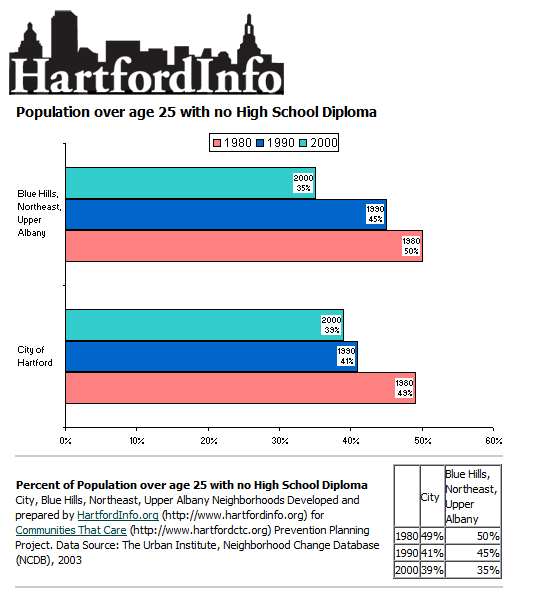
    hartford-no-diploma-rates-1980-2000-as-of-101716
    When a picture is worth a 1000 High School Degrees…

    In a written response to Ansari’s letter, Hartford Board of Education Chairman Richard Wareing wrote that the proposals are merely the suggestions of a consultant and do not represent any decision-making by the board.

    In an article written on April 28, 2015, the Hartford Current posted this statement: HARTFORD — A 3-mile swath of North Hartford has been named a Federal Promise Zone, a designation that local leaders hope will spark an infusion of manpower and money to one of the capital city’s neediest areas. The Federal Government provided grant money (aka Promise Zone) to the tune of  $2,000,000  eligible applicants must be State, local, or tribal government entity, represented by a Chief Executive, such as a governor, mayor, or other elected leader, or the head of a State, local, or tribal agency.

    hartford-northeast-incarceration-rate-2003-as-of-101716
    The area with the highest rate of incarcerated persons is the North East District.


    “We are deeply concerned and disturbed by the actions of the Hartford Board of Education, for systematically divesting in schools located in the north-end; leaving our students and families ill-equipped to compete educationally,” Ansari wrote.

    Where are the parents, who let the school system get to this state, what agency is angry with what organization for not sharing in the wealth of our failing school system?

    Sources:

    NAACP: Closing Schools In Hartford’s North End Would Violate Civil Rights
    Hartford’s North End Designated Federal ‘Promise Zone’
    Federal Promise Zone US Grant
    Graphs


wpChatIcon
wpChatIcon